

[International Women’s Day to Earth Day Series #1] Why is the World Starting to Discuss Gender-Responsive Just Transition?
從婦女節到地球日專題文章介紹
台灣綠能公益發展協會近幾年持續推動氣候和能源正義,觀察到在台灣的氣候變遷和淨零轉型領域中,性別與公正轉型議題還有很多發展和討論的空間,因此在2024年3/8婦女節到4/22地球日的期間發布一系列的文章,希望拋磚引玉,探討性別回應淨零公正轉型是否可能為台灣淨零轉型帶來新機會。
Introduction to the Series: International Women’s Day to Earth Day
In recent years, the Taiwan Green Energy for Charity Association has continuously promoted climate and energy justice. We’ve observed that within Taiwan’s climate change and net-zero transition efforts, there’s significant room for development and discussion regarding gender and just transition issues. Therefore, from International Women’s Day (March 8) to Earth Day (April 22) in 2024, we are releasing a series of articles. We hope these pieces will spark further discussion and explore whether a gender-responsive net-zero just transition can bring new opportunities for Taiwan’s net-zero efforts.
1. 國際上為何開始談性別回應公正轉型?
全球正在氣候變遷、環境變化和全球社會經濟動態的交匯點上,人們必須認識到氣候變遷對社會經濟產生深遠的影響。極端天氣事件奪走了人類的生命,也破壞生計與社會發展,加劇不平等並使人們陷入貧困(IPCC;2022)。如果不盡速採取行動,到 2030 年,氣候變遷可能會使多達 1.32 億人陷入極端貧窮(Jafino 等;2020)。全球氣溫升高對勞工的安全和健康構成威脅,並造成生產力損失(國際勞工組織(ILO))。全球有 12 億個就業機會仰賴生態系統服務和穩定的氣候(ILO;2018d),及時採取行動因應氣候變遷對於有尊嚴的勞動和實質永續發展至關重要。這也是為什麼世界各國作為聯合國氣候變化綱要公約(UNFCCC)的締約方所簽下的巴黎協定中,也加入了公正轉型的內容,確保不遺落任何人。
若進一步探究公正轉型,便會發現公正轉型之下,國際上還細分不同的族群需求來檢討公正轉型策略的制定方向。其中一個重要切入角度便是氣候變遷與性別。氣候變遷對女性和男性的影響不同,即使淨零轉型與調適經濟可能成為經濟增長和體面工作的推動因素,但就業的增減將會以不同方式影響女性、男性和其他群體,當中存在重現和強化不平等模式的風險,並不一定是大家期待的減少風險。因此,在前人的努力之下,UNFCCC下於2009年成立了婦女與性別社群(Women and Gender Constituency,以下簡稱WGC),是UNFCCC架構下 9 個具有官方觀察員身分的非政府組織社群之一,可以參加每年締約國大會的正式會議。WGC帶動來全自球各地的婦女及環境保護的團體,從提倡性別正義及以女性權利的角度來對抗氣候變遷,包含性別公正轉型。
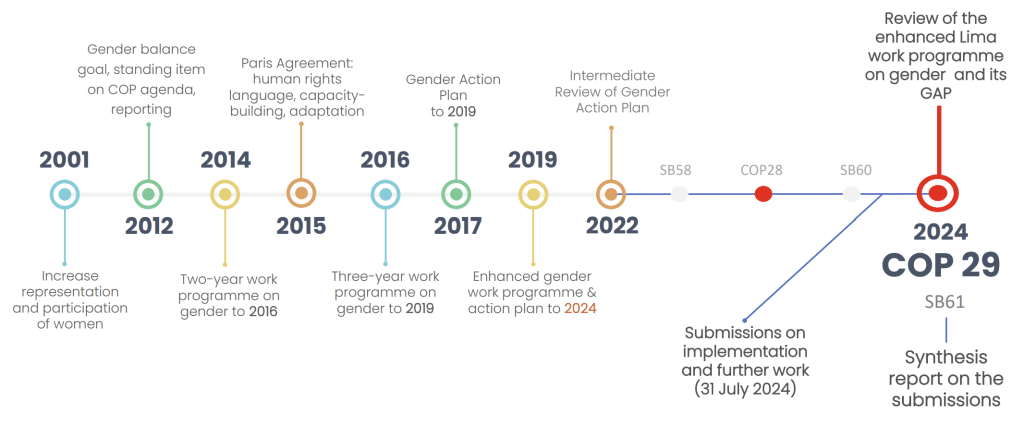
圖1. UNFCCC中的氣候性別議題重要事件發展時序(來源:COP28性別說明會簡報,https://unfccc.int/sites/default/files/resource/Information%20Session%20on%20Gender%20at%20COP%2028.pdf)
國際上性別公正轉型的概念作為女權的一部分來討論已有十年的時間,在UNFCCC之中,性別層面的討論在2021年的第26屆締約方大會(The 26th Conference of Parties,COP26)才逐漸成主流之一,當時締約方通過了一項決定,邀請ILO撰寫一份技術文件,探討促進性別平等的氣候行動和公正轉型之間的關聯,以促進低排放經濟中所有人的包容性機會。2022年的COP27則為了強化五年一期的「利馬性別工作計畫」(Lima work programme on gender) ,針對工作計畫中的性別行動計畫(Gender Action Plan,GAP)的進行中期審查,確認執行和修正情形。基於上述進度,2023年於杜拜舉辦的COP28也為了性別議題的討論安排了一列的對話和周邊會議,本專題下一篇文章COP28如何炒熱性別回應公正轉型議題將介紹台灣綠能公益協會在參與COP28時所關注到的性別主題日主要活動。
1. Why the International Focus on Gender-Responsive Just Transition?
The world stands at the intersection of climate change, environmental shifts, and global socioeconomic dynamics, making it crucial to recognize the profound impact of climate change on society and the economy. Extreme weather events claim lives, devastate livelihoods and social development, exacerbate inequalities, and push people into poverty (IPCC; 2022). Without urgent action, climate change could plunge up to 132 million more people into extreme poverty by 2030 (Jafino et al.; 2020). Rising global temperatures threaten workers’ safety and health, leading to productivity losses (International Labour Organization (ILO)). Globally, 1.2 billion jobs depend on ecosystem services and a stable climate (ILO; 2018d). Timely action on climate change is critical for decent work and substantive sustainable development. This is why the Paris Agreement, signed by nations worldwide as parties to the United Nations Framework Convention on Climate Change (UNFCCC), included provisions for a just transition to ensure no one is left behind.
Delving deeper into the concept of just transition, it becomes clear that the international community further disaggregates different group needs to refine the direction of just transition strategy formulation. One crucial entry point is the intersection of climate change and gender. Climate change impacts women and men differently. Even though the net-zero transition and adaptive economies may drive economic growth and decent jobs, the increase or decrease in employment will affect women, men, and other groups in varying ways. This carries the risk of reproducing and reinforcing existing patterns of inequality, not necessarily reducing risks as generally hoped. Therefore, thanks to the efforts of predecessors, the Women and Gender Constituency (WGC) was established under the UNFCCC in 2009. The WGC is one of nine officially accredited non-governmental organization constituencies under the UNFCCC framework, authorized to participate in the formal meetings of the Conference of the Parties each year. The WGC brings together women’s and environmental protection groups from around the globe to combat climate change from a perspective of gender justice and women’s rights, including gender-just transition.
The concept of gender-just transition has been discussed internationally as part of women’s rights for a decade. Within the UNFCCC, gender-related discussions only gradually became mainstream at the 26th Conference of Parties (COP26) in 2021. At that time, parties adopted a decision inviting the ILO to prepare a technical paper exploring the links between climate action and just transition in promoting gender equality, to foster inclusive opportunities for all in a low-emission economy. COP27 in 2022 aimed to strengthen the five-year “Lima work programme on gender" by conducting a mid-term review of the Gender Action Plan (GAP) within the work program, confirming its implementation and necessary adjustments. Based on these developments, COP28, held in Dubai in 2023, also arranged a series of dialogues and side events dedicated to gender issues. The next article in this series, “How COP28 Boosted the Gender-Responsive Just Transition Discussion," will introduce the main activities of Gender Day that the Taiwan Green Energy for Charity Association focused on during its participation in COP28.
 台灣綠能公益發展協會
有一則關於 【從婦女節到地球日專題文章#1】國際上為何開始談性別回應公正轉型? 的留言